Saturday, October 27, 2012

Popping about the Properties of Multiplication

Properties, properties. So many to teach and so little time. Not to mention what an abstract concept it is for students to understand. Here are some tricks I use when teaching the properties of multiplication:

1. Commutative- Before I start I have students use a Thesaurus to find lots of synonyms for the word talk. We make a word web of all of the words. One of the words is always communicate. We talk about what communicate means. It means to say something by talking, writing, using sign language.... Then I show the problem 4 x 3= and I ask them what is another way we can say the same problem...3 x 4. We can show that the 2 problems communicate the same thing like this 4 x 3=3 x 4. Since the two are communicating the same things we say that they are the Commutative Property-the order in which you multiply two factors does not matter the product will always be the same.

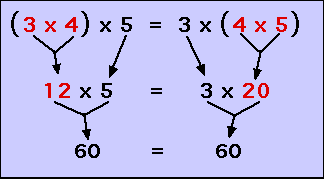
2. Associative- We start by talking about friends. Friends are the people we choose to be with. When we are on the playground or in the lunchroom, we group ourselves with our friends. Another word for grouping is associating. We associate with our friends. Associate means to group. When we multiply 3 or more numbers, we can't multiply all of them at the same time so we group them or associate them. To show the grouping or associating, we use parentheses to show which numbers we are grouping together first: 3 x (5 x 6)=3 x 30=90. The Associative Property says that it does not matter which two numbers you group together or associate first, the answer will still be the same. We show the Associative Property like this: 3 x (5 x 6) = (3 x 5) x 6. When we are multiplying the factors 3, 5, and 6, it does not matter which two we group or associate together first. When we find the final product, the answer will always be the same.

3. Identity-I like to talk about secret identities. The kids really get into it: Spiderman is Peter Parker, Batman is Bruce Wayne, Superman is Clark Kent, Hannah Montana is Miley Cyrus....They are not two different people. They are the "1" and the same person. Their secret identities (Peter, Bruce, Clark, Miley) are their real identities. It is who they are and adding a costume or a wig does not change who they are. The Identity Property of multiplication shows that a number can stay the same when we multiply it by a certain factor. Then I show them the following facts: 4x0=0, 4x1=4, 4x2=8, 4x3=12. Which one allowed the 4 to keep its identity? 4x1=4. The identity property states that any number multiplied by a factor of 1 stays the same.

 
I use a PowerPoint presentation to teach students about the Properties of Multiplication. You can find it at my TpT store.
 
 
I also use this packet that has tons of printables, activities, games, student notes, an assessment, and so much more to teach students about the properties of multiplication.


 You can find the Popping about the Properties of Multiplication at my TpT store.


See how I use all of this in my classroom at my classroom website, Mrs. Hill's P.I.R.A.T.E.S.

 Mrs. Hill's Perfect P.I.R.A.T.E.S.


Saturday, October 20, 2012

Freebies for Upper Grades

Hocus Pocus with a Giveaway Focus!!  Halloween's just around the corner, and I have to admit it's one of my favorite holidays!  Ghost stories, pumpkins, candy corn and excitement fill the air. It can only mean that we teachers need to prepare for our classroom gremlins' dynamic desires to Trick-or-Treat this season AND fast! Why not get ready for celebrating this festive occasion by entering my HUGE Halloween giveaway?


It even includes a $25 gift card to the amazing black-and-orange company, Amazon.com!

Not to mention, you
have a chance to win 19 high-quality HALLOWEEN products specifically designed for upper grade students from some amazing
and very generous TpT sellers!

Thursday, October 11, 2012

The Mystery of Multiplication

Multiplication has come a long way since we were in elementary school. We were handed a list of facts and told to memorize. I don't think we even questioned why 4 x 9 equaled 36. We just accepted it.

Things are so different today. Kids not only have to know that 4 x 9 equals 36, they also have to know why. In other words, how do you know? Prove it to me. Which is perfect for my math motto: PROVE IT! DON'T JUST CHOOSE IT!

Our standards no longer just require students to answer the basic fact. The new standards require students to show what 4 x 9 looks like using groups of objects, arrays, and repeated addition. I have created the following products to help my students master these concepts:

I use this Meaning of Multiplication PowerPoint presentation over a week long period. I take each meaning one day at a time. I embed videos and online games into it, so that we can just click and go.

I also use The Mystery of Multiplication lesson and activity packet to provide lessons, printables, games, activities, graphic organizers, and more.


Monday, September 24, 2012

Give and Take

In my previous post, I discussed different ways of teaching addition with regrouping. One strategy I teach is the Give and Take Method. It allows students to completely avoid regrouping by getting one of the addends to the nearest ten. And whatever they give they have to take from the other addend.

The first step is to look in the ones place. Decide which digit is closer to a ten. In the example, it is the 8. What do you add to 8 to get it to the next tens number? 2. If you add 2 to the 8, then you have to take 2 from the 4. Now look at your new problem. You can solve it without regrouping. The method works really well with 2 digit numbers. I use it with kids who have trouble remembering to regroup or add in the ten that was regrouped. I also use it as a way to check problems that have been worked out using a different strategy. Plus, it gives kids extra practice with addition and allows some practice with mental math. After a while, many use this method to work problems out in their heads.


To introduce and review tens bonds, I show the following video. It is a favorite of my students! We watch it over and over again. It warms them up for this strategy and makes it so much easier. Check it out!


Sunday, September 23, 2012

Awesome Addition

Wow! We have come along way from when we were growing up and learning how to add. When we were learning facts, we were just told to memorize. You didn't need to know why 4 + 3=7. All you needed to know was that it was 7! You just learned your facts.

Then when we moved to adding 2 and 3 digit numbers, all we knew was that we stacked up the numbers and remembered those facts. If there was a number bigger than 9 in a position, we "carried" the other number to the next place. No one explained why. No one told us that the 1 in 12 was really 10 ones that could be regrouped into 1 ten and then that is why it was moved to the tens place.

Now we not only teach kids this but we expect them to be able to convey it on state and national tests. We no longer want to know that 53 + 29 is 82. We want to know "how did you find that answer", or "what method did you use to solve your problem", or "how did you use mental math to help you".

In other words, students must be able to show the "how" and the "why" and not just the "what". The problem is that anyone who has been teaching more than five years never learned how to teaach like this. All we know is the "old school" algorithm.

Through out my thirteen years of teaching, I have been criticised for teaching students using unconventional methods, especially when it comes to addition, subtraction, multiplication, and division. Teachers have told me that kids have to know how to do it the traditional way! Why? Does it say it in a standard somewhere? Oh, it is in the book? Well, guess what...math books are becoming obsolete...so you might want to stop resting on your laurels and the way we have always done it and spread your wings a little bit.

I have created 2 different PowerPoint presentations on Addition With Regrouping and Addition Without Regrouping. These presentation include many different strategies for adding numbers, like drawing the problem out, expanded form, branching, a method called Give and Take, and even...Old School. You can see my


I have also created a packet entitled Autumn Addition that includes lessons on each method of addition without regrouping. It includes printables, rules, games, and more!


Finally, I have created a unit for teaching addition without regrouping entitled Game On:Addition with Regrouping. It includes lessons on each of the methods of branching, drawing, expanded form, give and take and old school. It has printables, activities, games, and songs to make learning about the "how" and "why" of addition with regrouping engaging and fun!


Thursday, September 13, 2012

Happy Birthday, Johnny Appleseed!

Every year, I love when fall comes to town. Football, leaves, cooler weather, Halloween, and Johnny Appleseed. I know that sounds like an odd thing to get exceited about but Johnny Appleseed Day is one of my students' most favorite days.

We dedicate the whole day to Johnny and his Apples. We do art projects, make applesauce, weigh and measure apples, research, read books about Johnny, and even have an Applicious Party at the end of the day complete with caramel apples, Apple Jacks, apple chips, apple pie and much more.

I have always had an assortment of activities and printables that I have acquired throughout the years. Most were great activities but they had just started to fade. Others needed a little vamping up. So I have created a whole new Thematic Plan to make for one sensational Johnny Appleseed Day. Check them out at my TpT store.

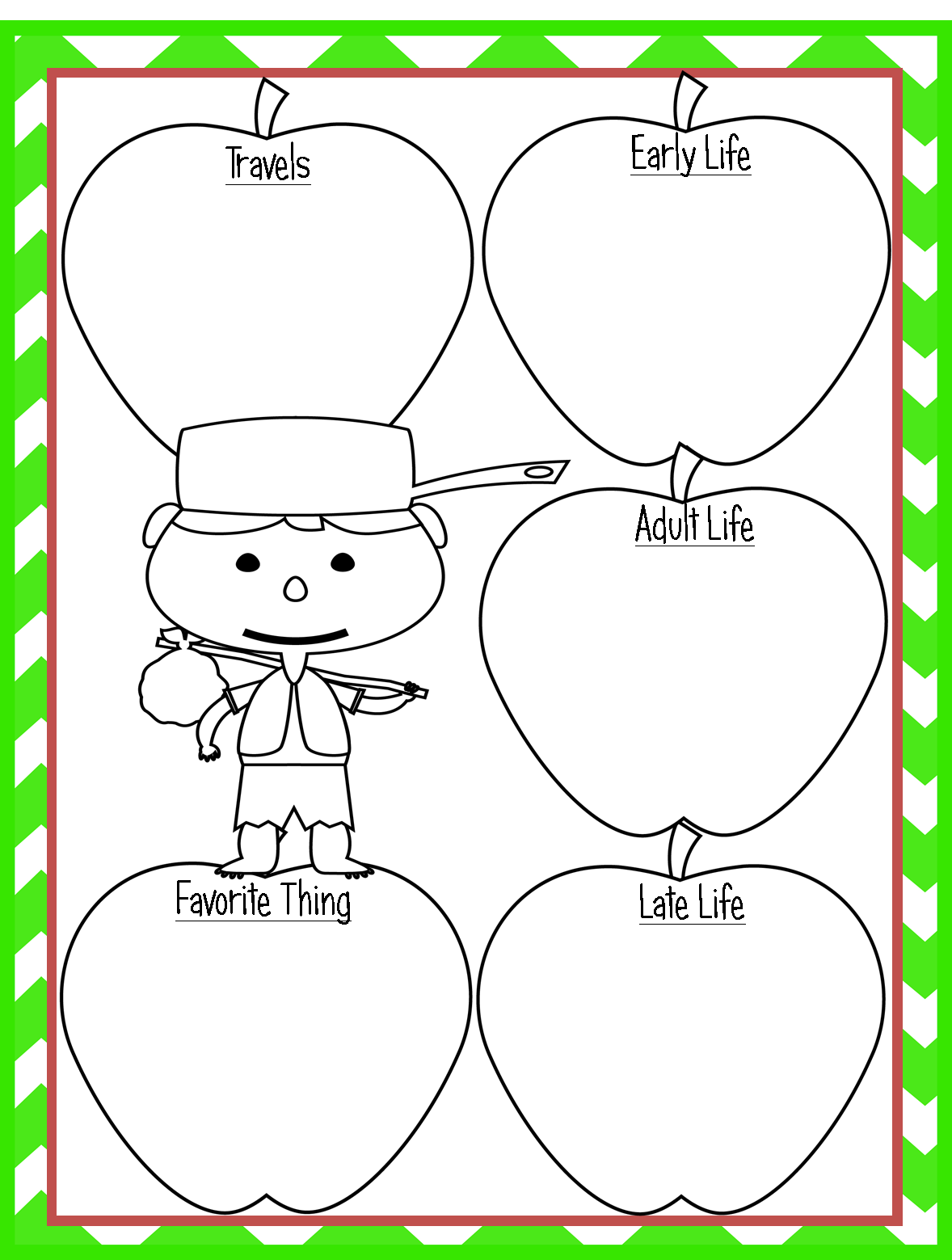
There is an expository writing lesson on How to Make Applesauce. A Bushel Full of Math Centers sends kids exploring apples in whole new way by weighing, sinking, measuring, researching, drawing...and so much more. They will read a folktale about A Little Red House and create a comic strip about the story's events. Next they get to travel through Johnny the United States and create a graphic organizer about his life.


Wednesday, August 29, 2012

Singing Across the Curriculum

Since my first year teaching all those long (13) years ago, I have always tried to make learning fun. One way I have accomplished this is to integrate singing, rapping, and cheering into all of my classes across the curriculum.

These songs are a staple for my math class. We literally sing at least 4 of them every day. They have become an asset when 
teaching rounding, place value, number forms, problem solving, estimation, subtraction, multiplying by multiples of tens, and much, much more. 

We “Sing Across the Curriculum” not only to make learning fun and engage students in learning, but also so that students can use their songs to help them solve problems. Nothing makes me happier than when students are taking a test and I can hear them quietly singing their songs!

I have just posted my first edition of "Singing Across the Curriculum: Math Songs-Numbers and Operations". It includes my favorite songs that help my students in numbers and operations. Most of them former students had a part in making up! 

Check them out at my TpT store.
 
Here are some of my kids having fun with them!