"Take a Penny" is a 2 step strategy that allows students to subtracting across zeros without having to go through the complicated steps of regrouping. In fact with "Take a Penny", students can subtract across zeros without regrouping at ALL!
I learned the "Take a Penny" strategy last summer, and it has transformed the way my students subtract. I was at one of those workshops that you really don't want to be at but are required to go to, and boy was I amazed. The man that came to talk to us knew exactly how it felt to be in our shoes and did not waste one second of our time.
He taught us all kinds of strategies to make learning about math not only easier but fun. He only talked to us for two days, but I swear I would have sat there for a week just to learn more ways to help children understand and comprehend math in ways that we have never heard of.
I have used many of his strategies this past year, but the one that has had the most monumental change is the "Take a Penny" strategy. I actually feel like I have cheated my past classes by not teaching them this strategy. Not only is it faster, but because there are less steps students rarely make mistakes.
And it works every time, no matter how many zeros you have. The reason it works is quite simple. When you are subtracting two numbers, you are finding the difference between them or how far apart they are. When you "Take a Penny", you are not changing the distance between the two numbers because you are doing the same thing to both numbers. You are just make it easier to find the distance between the numbers.
I created a 23 slide PowerPoint presentation to help students and teachers master this innovative strategy. This product introduces how to "take a penny" and then provides an abundance of practice in working subtraction problems that require regrouping across zeroes using this extremely innovative strategy. Check it out at my TpT store. I promise that it will forever change the way you and your students subtract!
Wednesday, June 13, 2012
Monday, June 11, 2012
Orderly Organization
This summer is all about organization for my home, my classroom...my life.
What are the best things you have done to help organize your life? Do you have some "must-dos" for me? Any help would be greatly appreciated! Also, it would probably be a lot easier to do this if I would stop "pinning" ways to get organized and actually get started getting organized.
Monday, May 28, 2012
Rounding Numbers Round Up
I still remember my first couple of years teaching rounding numbers. It was so hard. I had the most difficult time getting through to children. They just could not understand when to round up and when to round down using the only tool I knew to use at the time: the text book.
Finally, two fellow teachers and I created a song that 10 years later is still helping my students be successful with rounding.
In addition to the song, I developed a technique that has helped countless groups of students master the difficult concept of rounding numbers. This method helps students remember what place they are rounding to, focus on the number that tells you whether to go up or go down, and how to remember that everything turns to zeros.

I developed a packet to teach others this method. It includes notes for teachers, the unique song that we created all those many years ago, several printables on rounding to the nearest ten, hundred, and thousand's place, a Rounding I Have:Who Has game, and a list of Rounding Resources including videos, websites, and games.
See a preview of it at my TpT store.
I also have several estimating and rounding PowerPoint Presentations and a multiplying by multiples of tens and hundreds at my store and on my Facebook page.
Finally, two fellow teachers and I created a song that 10 years later is still helping my students be successful with rounding.
In addition to the song, I developed a technique that has helped countless groups of students master the difficult concept of rounding numbers. This method helps students remember what place they are rounding to, focus on the number that tells you whether to go up or go down, and how to remember that everything turns to zeros.

I developed a packet to teach others this method. It includes notes for teachers, the unique song that we created all those many years ago, several printables on rounding to the nearest ten, hundred, and thousand's place, a Rounding I Have:Who Has game, and a list of Rounding Resources including videos, websites, and games.See a preview of it at my TpT store.
I also have several estimating and rounding PowerPoint Presentations and a multiplying by multiples of tens and hundreds at my store and on my Facebook page.
Sunday, May 6, 2012
Career Day
The end of the school year is rapidly approaching. In fact, we only have 10 days left! I can't believe it. This year has completely flown by...in the blink of an eye.But in that same blink, the behavior of the students has gone off the deep end. They are ALMOST as excited about the upcoming summer as we are. The massive full moon does not help at all! It is crazy up in here!!
So we are trying very hard to survive. And the best way to survive is to engage children. To get them excited about something, excited enough to try to behave. This year we have planned several educational, exciting, and engaging activities. We have a walking field trip touring our downtown, a 2nd/3rd grade picnic/orientation where our third graders will share their favorite memories and give them a tour of their future classrooms, and we will celebrate all of the places they will go with Career Day.I created some phenomenal activities to help students share the career they chose to dress up as, research careers, set goals, and learn about all of the options that await them in this big world we live in as long as they keep their head on straight and pursue their dreams.
My Career Day packet includes a graphic organizer for researching, a crossword and word search puzzle, "My First Resume" sheet, an "I Have, Who Has" game...and much, much more! Check it out my "Career Day: Oh the Places You'll Go" packet at my TpT store.
Esti...Who?
Estimation! I love teaching estimation. It is so much fun when students realize how much easier it is to estimate the answer to two numbers than to add, subtract, or multiply them together. Over the years I have developed all kinds of tricks for teaching estimation.
My most effective trick in helping students remember how to round and estimate is the integration of some of my unique songs, chants, and raps. The first song I created help students remember when to round up or round down.
Next I created a song to help students remember the steps to estimation. Students frequently want to add, subtract, and multiply first and then round their answers. The problem is that it could result in a wrong answer on a test. They need to remember to round first and then add, subtract, or multiply. You can hear the tune of the song when you purchase my Estimating with Addition and Subtraction PowerPoint Presentation at my TpT store. (I honestly could not figure out how to add the sound here and I made up the tune.)
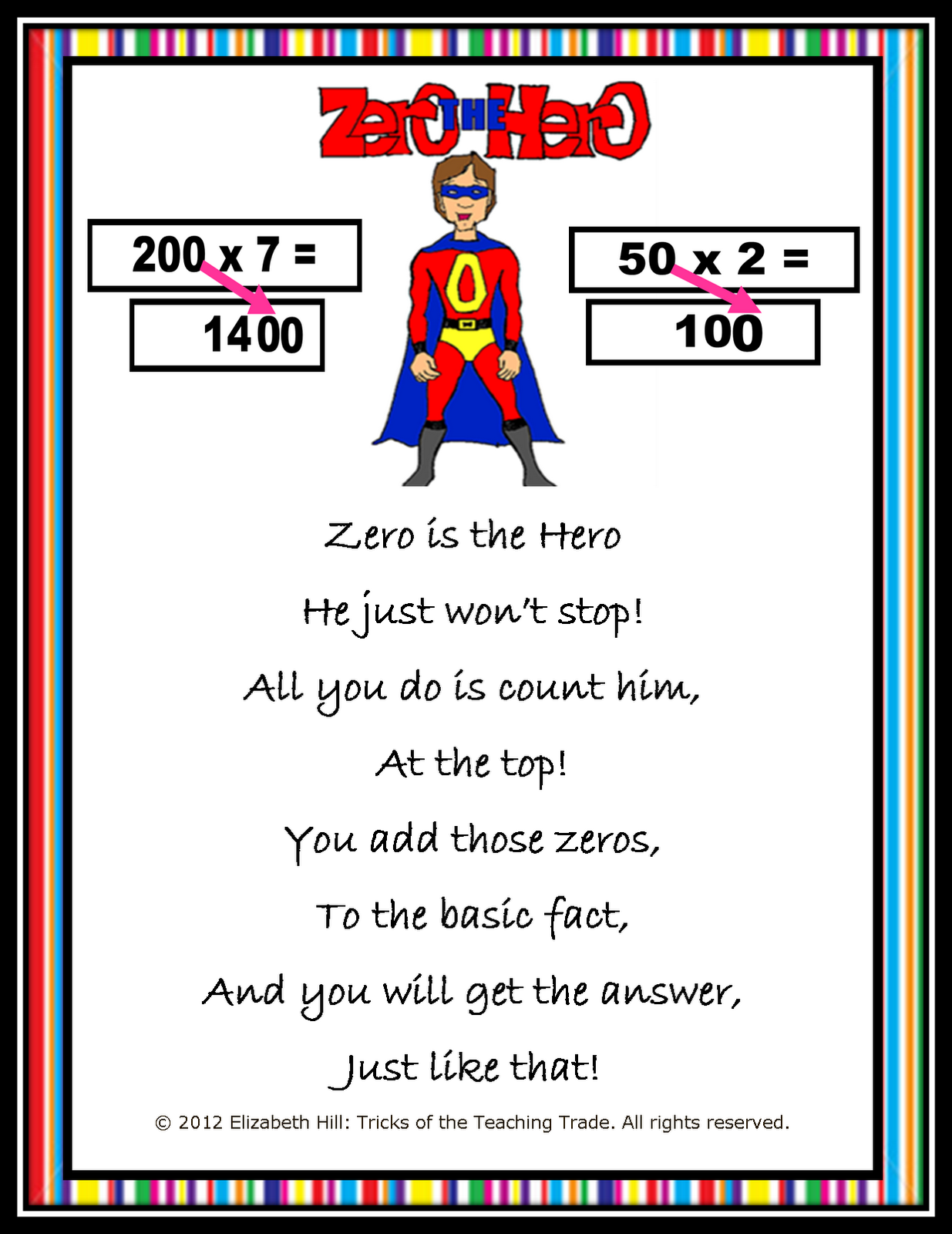
Finally, I (with the help of a class a few years ago) created a song to help students remember how to multiply after rounding by multiplying by multiples of 10's, 100's, and 1,000's.
You can hear the unique tune of Zero the Hero and get so fantabulous teaching tools, tips, and lessons when you purchase my awesome PowerPoint presentation Estimation with Multiplication from my TpT store.
Here are some of my favorite videos and songs from YouTube and United Streaming that I use when teaching my units on Estimation:
My most effective trick in helping students remember how to round and estimate is the integration of some of my unique songs, chants, and raps. The first song I created help students remember when to round up or round down.
Next I created a song to help students remember the steps to estimation. Students frequently want to add, subtract, and multiply first and then round their answers. The problem is that it could result in a wrong answer on a test. They need to remember to round first and then add, subtract, or multiply. You can hear the tune of the song when you purchase my Estimating with Addition and Subtraction PowerPoint Presentation at my TpT store. (I honestly could not figure out how to add the sound here and I made up the tune.)
Finally, I (with the help of a class a few years ago) created a song to help students remember how to multiply after rounding by multiplying by multiples of 10's, 100's, and 1,000's.
You can hear the unique tune of Zero the Hero and get so fantabulous teaching tools, tips, and lessons when you purchase my awesome PowerPoint presentation Estimation with Multiplication from my TpT store.
Here are some of my favorite videos and songs from YouTube and United Streaming that I use when teaching my units on Estimation:
Monday, April 23, 2012
Math Confusion
My idea for Math Confusion came from the fitness craze, Cross Fit. The goal with Cross Fit is to do many different activities in a short amount of time, switching it up so that your muscles never know what is coming next. You work out your arms, then do cardio, then do abs, then do legs...and repeat as many times as you are able to make it through the circuit. It makes your muscles stronger and burns more calories because the muscles are working harder when the exercises are not repetitive.
So as we were coming back from a field trip one day, I thought about using the same idea for a math review. Math Confusion uses the same idea as Cross Fit. Students work on lots of different math concepts in a short amount of time. They rotate from station to station working on place value, fractions, multiplication, addition… They get 2 minutes at each station and must try to get as many questions right as possible. The Confusion continues until time is up. The goal is for students to make it through the circuit as many times as they can in the time allowed and to get as many cards right at each station as possible.
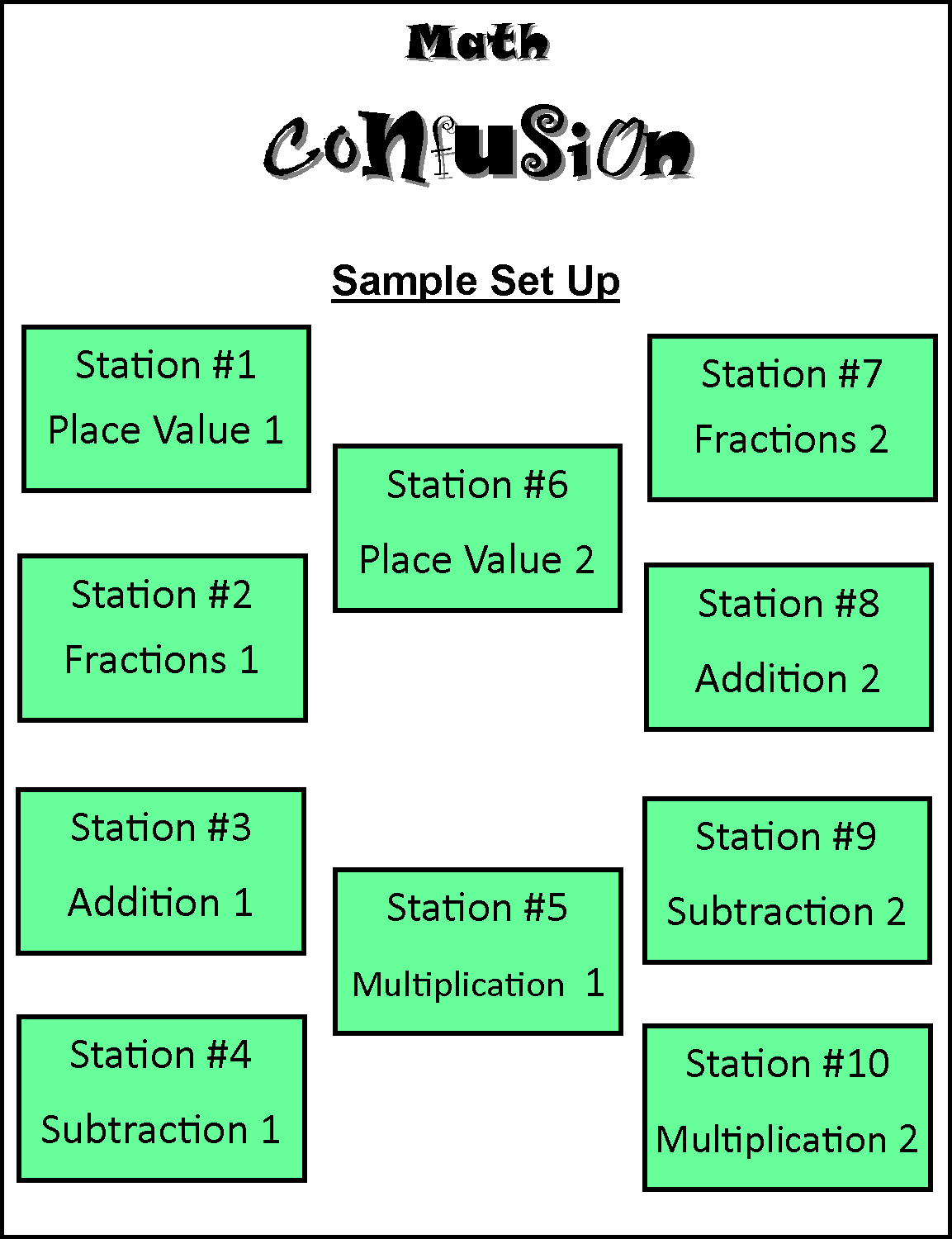
I created 11 stations 2 place value, 2 addition, 2 subtraction, 2 multiplication, 2 fraction, 1 number forms. I printed the circuit (instruction) card and activity cards on card stock and laminated them for safe keeping. I folded the circuit card in half and added Velcro to the inside to make a little pocket for the cards to fit in. All 11 stations fit nicely into a gallon Ziploc bag.
I set the stations up so that none of the same skills are side by side, hence the CoNfUsIoN! Here is an example of how I set up the stations:
Next I divide the students into groups of 2. Each group rotates from station to station spending 2 minutes at each station. There are 32 activity cards at each stations so it is rare for any group to finish a station before time is called.
Here is how I explain the confusion to the students:
There are stations set up around the room. At each station, there is a set of cards face down. I am going to assign you to stations where you will sit and wait until I say go. When I say go, you are to turn over the first card and write, down the answer as quickly as you can. After you have written down the answer, turn the card upside down and check to see if you got it right. Remember, don’t cheat. If you cheat your muscles (brain) want get any bigger (smarter). If you get it right, put it off to the side. If you get it wrong, put it back into the deck of cards on the bottom. When I say stop, you must stop writing and count the cards you got right. Then place all the cards back in the deck face down, and return the station to how it was when you started. Do not rotate to the next station until I give the signal. When I give the signal, rotate to the next station. Sit down and don’t touch anything until I say to start. Remember, the goal is to get as many right at each station as you can and to get around to every station. Are there any questions?
This was one of the best reviews I have ever done in my classroom. It reviewed every concept in Numbers and Operation in less than a 30 minute period. Check it out at my TpT store! Download the free preview, or get it to use in your classroom. I was so pleased, and I am going to soon begin working on the Geometry, Measurement, and Algebra versions.
Sunday, April 22, 2012
K-5 Learning Review
I recently had the awesome opportunity to review a great learning program: K5 Learning. K5 Learning (www.k5learning.com) is an online reading and math program for kids from kindergarten through grade 5. Our intent is to help kids build reading, math and study skills through independent study. K5 is designed for home use and can be used for after-school, weekend and summertime supplemental study or in conjunction with a homeschooling program.
Kids complete an online assessment of 8 key reading and math skills, and then work independently at their own pace through over 3,000 online lessons and activities. The lessons are animated, interactive and simple enough that a 4-5 year old can use them independently. We automatically choose lessons for students (based on their assessment and past lessons), track student progress and provide reports for parents.
Benefits for Kids
K5 helps kids learn essential reading and math skills, develop good study habits, and fulfill their academic potential.
Benefits for Parents
K5 makes life easier for parents by allowing for effective, independent study by kids. Simplified interfaces, automatic lesson selection, student tracking and reporting all contribute to minimize the amount of daily supervision required.
When you first sign up, there are several helpful videos to get you started. They introduce you to the program, guide you through setting up assessments, and are there to answer any questions that may arise as you use the program.
I used the program with my 7 year old second grader, my 4 year old Pre-K student, and my 8 year old niece who is also in the second grade. I started with my children. Both are above grade level. My 7 year old is currently in the gifted program. After seeing how much they enjoyed the program, I signed my niece up. She struggles in math, so I knew the extra practice would be good for her.
All of the girls enjoyed the program. They liked the graphics and interactions the best. The games at the end of each lesson were an added incentive. However, they sometimes got bored with them because, even though they were great games, they seemed to be the same games over and over again.
I noticed all of the girls grew stronger in math and reading over the 6 week period that we utilized the program. My pre-k student impressed me the most by how much knowledge she gained in phonics and reading. I was worried that the lessons were going to be too hard for her but she seemed to really enjoy them. In fact, she was the one who constantly reminded me that it was time to practice her reading and math. I think she will be sad that our trial period is over.
I enjoyed the fact that my children could log into the program and start a lesson without any assistance from me. It was something they could do while I was working, and whereas the lessons did challenge them, they were easy enough for them to complete on their own.
I do wonder what standards the leveling is based on. When the assessment comes back and says that my Pre-K student is on a 1st grade level when it comes to phonics, what standards are they using to base this level on. Of course, that is the teacher in me coming out.
Speaking of being a teacher, this program would be extremely beneficial in after school programs and home school situations. It provides independent practice, support for students who are struggling with concepts, acceleration, and review with extra practice.
A few changes I would make would be that the assessments should be automatic. You should not have to request them. Before a child ever starts the program, they should be assessed in order to be placed on the appropriate level. There should also not be a limit on the grade levels above where a child is. For instance, my second grader scored on a 4th grade level in several areas but the program would not put her on that level unless I requested it. This resulted in her being bored a few times.
Something I would like to see added to K5 Learning would be an incentive program. This would be great and extremely motivating. It could be like a virtual bulletin board where they can pin their completions of levels and tests and print out certificates and awards for their successes.
This program is definitely something I would encourage parents to obtain for their children. It is a little pricey but the benefits definitely out weigh the costs.
My Pre-K student said, "It is very good! I like it a lot. I love reading now. It is my favorite part, but math is a little hard. And thanks for letting us use it."
My second grader said, "I like it because you can go to a spelling bee and it lets you read non-fiction and fiction books. You can also go to math and reading. On math, you can count, round, add, subtract, and lots of things."
Subscribe to:
Posts (Atom)